
The error message “BOOTMGR is compressed Press Ctrl+Alt+Del to restart” may appear when you start up your computer.
If you press Ctrl+Alt+Del that just restarts the computer and then displays the same error message again.
I saw this error recently on a customer’s computer and thought I’d share how to fix it – the error can affect Windows 10, 8, 7, Vista and XP computers.
What Is BOOTMGR?
BOOTMGR refers to the Boot Manager – an important Windows system file. If it is compressed, it can’t be used and Windows can’t start (boot up). The file must therefore first be uncompressed for Windows to be able to boot properly.
File compression used to be a good way to save hard drive space – back in the days when hard drives were maybe 2 or 20 GB in size…
However, modern drives offer hundreds (or thousands) of GB storage so there really is no need to compress files.
Why is BOOTMGR Compressed?
There are two likely reasons that it may have been compressed.

- 1. You installed a ‘Speed Booster’ or ‘System Optimizer’ type of program – perhaps one with grand claims of boosting performance and with a super duper registry cleaner thrown in… See ‘do I need a registry cleaner’ – the short answer is No.
Such a program often causes this problem by compressing the whole of the system partition (usually the C: drive) to save space – including the crucial BOOTMGR file. This is what happened in my customer’s case.
File compression (even when done properly) may slow down system performance anyway so it is a lousy thing for a ‘speed booster’ utility to do…
- 2. You manually compressed the whole of the system partition (via the drive’s Properties window).
How To Fix BOOTMGR is Compressed Error
The fixes for Windows 10 and all earlier versions of Windows are very similar – they require you to recreate the BOOTMGR file.
Windows 10/8/7/Vista Fix
Boot into the System Recovery Options using the preinstalled Advanced Boot Options or a Windows installation/recovery DVD – see the illustrated tutorial at Sevenforums for instructions if required.
Select ‘Startup Repair’ and wait until the repair attempt completes. If successful you can then restart the computer and Windows may boot up normally.
If the repairs fail and/or the computer does not restart into Windows normally, proceed with the 5 step fix as follows:
Step 1
Boot into the System Recovery Options again but this time select ‘Command Prompt’ instead of Startup Repair – this will take you to a windows Command Prompt.
[Note: if using RAID for multiple hard drives you may not see your version of Windows listed in System Recovery Options, during the loading of the recovery process. In this case you would need to press ‘Load Drivers’ and browse to your RAID drivers so that your version of Windows can be listed.
Step 2
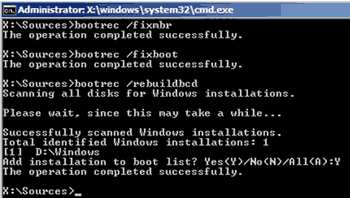
Type bootrec /fixmbr and press Enter.
Step 3
Type bootrec /fixboot and press Enter.
Step 4
Type bootrec /rebuildbcd and press Enter. Type Y and press Enter if asked to add the installation to the boot list:
Step 5
Now type Exit and press Enter to restart the computer. The error message should not appear and Windows should start up normally.
Windows XP Fix
You will need to have a bootable XP installation CD available.
Step 1
Log into the Recovery Console command prompt by following steps A to F in my article on fixing ntldr. You should now be in the C:\Windows directory.
Step 2
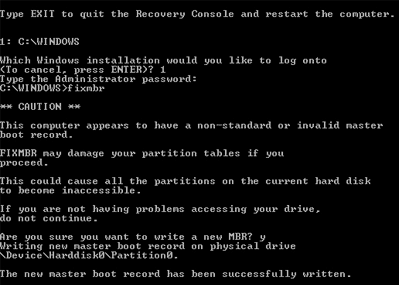
Type fixmbr and press Enter. Press y to accept the warning and proceed:
Step 3
Type fixboot and press Enter. Press y to to confirm and proceed:

Step 4
Type Exit and press Enter to restart the computer.
Step 5
The error message should not appear and Windows should start up normally.
Alternative BOOTMGR Is Compressed Fix
This fix should not be required but, if for some reason the previous fixes failed to resolve the problem, you may need to decompress all files on the system partition manually.
- Log into the System Recovery Options \ Command Prompt (Vista/Windows 7/8/10) or Recovery Console command prompt (XP).
- Type
compact /u /a c:\*.*and press Enter. The command may take a long time (hours) to complete on a very large drive – leave it until finished. - Once it finishes decompressing all files, type Exit and press Enter to restart the computer. The error message should not appear and Windows should start up normally.
Note: if your Windows system drive is not c: then change the c in the command to your drive letter e.g. d:\
What Does The Compact Command Do?
This command decompresses (/u) all files (*.*) on the c:\ drive including hidden and system files (/a).
Conclusion
Unfortunately Windows does nothing to prevent an ‘optimizing’ program (or a user) from compressing Bootmgr – even though it means that Windows will not boot…
However, this problem is relatively straightforward to fix and easy to avoid in future – don’t use system optimizing utilities that may compress the Windows system partition and don’t try to compress it manually.


i get your solution but my problem is that my dvd drive is not working so how do i fix this ‘bootmgr is compressed’ plz hlp
@Emang – if you don’t have preinstalled Advanced Boot Options then you could either 1. buy/borrow a working DVD drive (internal or an external USB one) or 2. take out the hard drive and plug into a working PC then manually uncompress all files on your drive from there.
Thanks Roy…
Anyone know how to run Windows again after the trial has expired?
@Craig, glad it helped you. If a trial has expired you would have to buy a license to activate it into a full W7 if you want to continue using it – for obvious reasons we can’t allow discussion of any non-legal options…
Thanks Roy, you ROCK!! BOOTMGR solved.
If all you see at startup is the error message then either you haven’t set the BIOS to boot from a DVD or aren’t using a bootable repair/installation disc?
DVD/CD must be first in the boot order (before hard drive) or it will try to boot to the hard drive first – see https://techlogon.com/how-to-boot-from-a-cd-or-dvd/ if you want a guide to BIOS boot setup.
Hey,I got the error message”BOOTMGR is compressed.Press Ctrl+Alt+Del”.I inserted the repair disc but I don’t get the option to repair even after restarting.I can’t even get to the command prompt or anything for that matter.Whatever I try I get the same error message.I’m running Windows 7 please HELP!!!
how do l fix error message “bootmgr is compressed” in windows 7
The article gives instructions for Vista/Windows 7 and an alternative…
thanks bigboss
I solved the problem using your tips. It was very helpful, thank you very much! :)
your the MAN
thank you! worked a treat for me :-)
thanks man u are great, didnt asked for a Y :)
Do I need to use an existing installer that I used to install my window 7 or even if not?
@William – not sure what you mean? If you don’t have preinstalled Advanced Boot Options then you need an installation or recovery DVD. The ‘tutorial’ link given in the article has a good illustrated guide on how to access Recovery Options
Thank you very much. The Repair didn’t work but the command line worked like a charm… :-)
It works perfectly. Thanks for that, it was great ;)
Glad it all worked out for you :-)